

Correcting a Bad Hairline Transplant: Repair Options

A poor hairline transplant isn’t automatically beyond repair. Correcting a bad hairline transplant may involve reshaping the hairline, removing or repositioning misplaced grafts, adding density, or using camouflage such as scalp micropigmentation. The options depend on what caused the unnatural appearance and how much viable donor hair remains.
If the result looks too low, straight, crowded or uneven, it’s understandable to feel disappointed or unsure what to do next. Some concerns can be addressed surgically, while camouflage may improve the appearance without another transplant.
This article explains why hairline transplants can look unnatural, how different repair approaches work and what affects their suitability. You’ll also learn why it’s important to allow time for growth to develop before judging a result, and which factors shape a careful assessment.
Table of Contents
Why Do Bad Hair Transplants Happen?
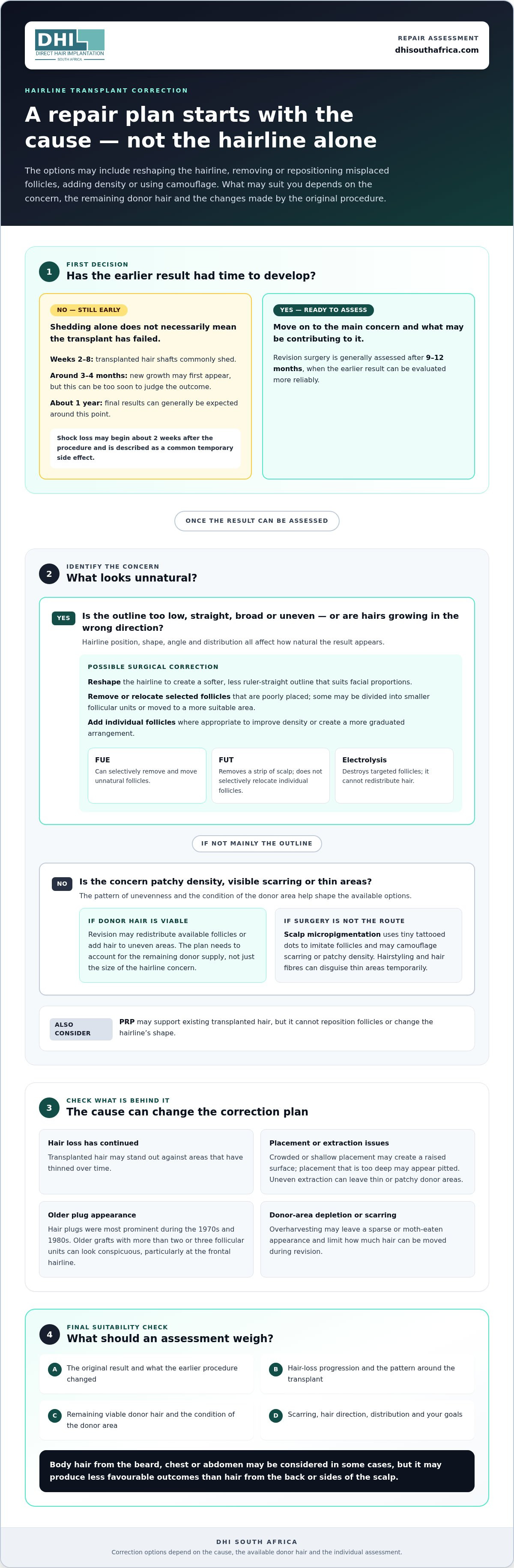
Correcting a bad hairline transplant can involve reshaping the hairline, removing or repositioning misplaced follicles, adding density or using camouflage. The right approach starts with identifying the cause, such as ongoing hair loss, poor placement or donor-area depletion. A consultation also considers how much viable donor hair remains and what the original procedure changed.
Some problems reflect the techniques used in earlier decades. Hair plugs were most prominent during the 1970s and 1980s. They involved removing round sections of skin containing multiple follicles and placing them in thinning areas. Older grafts containing more than two or three follicular units can create a visible plug appearance, particularly along the frontal hairline. Large, obvious grafts, visible scarring and a hairline that sits too low or looks unusually broad can also make results appear unnatural.
Extraction and placement errors can affect both the transplanted area and the donor area. Uneven extraction may leave thin or patchy sections, while overharvesting can create a sparse or moth-eaten appearance. Grafts packed too closely or placed too shallowly may leave a raised, goosebump-like surface; placement that is too deep can appear pitted. Hair loss can continue after surgery, making transplanted hair stand out against areas that have thinned over time.
Donor-area depletion limits how much hair can be moved during revision. Body hair from the beard, chest or abdomen may be considered for transplantation in some cases, but it may produce less favourable outcomes than hair from the back or sides of the scalp. Revision can redistribute available follicles or add hair to uneven areas. Each option must account for the remaining donor supply, not just the size of the hairline concern.
For the hairline itself, options include adjusting its shape, selectively removing or repositioning unnatural grafts, and adding individual follicles to improve density. The South African hair transplant information provides context on transplant planning. Revision surgery is generally assessed after 9 to 12 months, when the earlier result can be evaluated more reliably.
Early shedding doesn’t necessarily mean a transplant has failed. Transplanted hair shafts commonly shed during weeks 2-8, and new growth develops gradually. Hair may first appear around 3-4 months, but that can be too soon to judge the outcome; final results can generally be expected about 1 year after surgery. Shock loss may begin about 2 weeks after the procedure and is described as a common temporary side effect.
Yes, non-surgical options can improve appearance without moving follicles. Scalp micropigmentation uses tiny tattooed dots to imitate hair follicles and may help camouflage scarring or patchy density; hairstyling and hair fibres can also disguise thin areas temporarily. PRP Hair Loss Treatment may support existing transplanted hair, but it cannot reposition grafts or change the hairline’s shape.
Hairline design and natural-looking graft placement
A natural result depends on more than filling a receding area. Hairline position, shape, graft direction and density work together, so a mismatch in any one can make surgical hair restoration look unnatural.
Natural Hairline Shape and Placement
A natural hairline follows a soft, irregular curve rather than a ruler-straight line. Its position should suit the person’s facial proportions and account for how hair loss may progress, rather than simply recreating a youthful hairline. A line placed too low or too far forward can look disconnected from the face, especially if surrounding hair continues to thin. These design choices shape the appearance from the front and in profile.
Graft Direction and Survival
Graft direction describes the angle and orientation in which each follicle is placed. A different direction can make individual hairs stand out, even when density is adequate. Excessive shedding that continues beyond a few months may indicate poor graft survival, while patchy growth can point to uneven results.
Unnatural Graft Placement
An unnatural result may show a sharply defined edge, a very straight outline or grafts growing against the direction of nearby hair. Overcrowding can make the hairline appear harsh instead of gradual; gaps between clusters can create a patchy look. For example, a dense row of multi-hair grafts at the front may be more conspicuous than a graduated arrangement. Assessment should consider the outline, direction and distribution together.
Removing or Relocating Grafts
Correction may involve removing selected grafts, dividing them into smaller follicular units or relocating them to a more suitable area. FUE can selectively remove and move unnatural grafts, whereas FUT removes a strip of scalp and does not selectively relocate individual follicles. Electrolysis destroys targeted follicles rather than moving them, so it cannot redistribute hair. The method depends on graft position, surrounding growth and available donor hair.
A revision assessment can map which hairs are misplaced and which still contribute to useful coverage. It also considers the hair-loss pattern around the transplant, since further thinning may change how a revised outline looks over time. If you’re exploring surgical options in South Africa, the hair transplant information can help you understand the treatment context.
Camouflage repair using individual follicles
Camouflage repair aims to soften visible defects by replacing or supplementing hair in selected areas. Planning starts with the pattern of patchiness, the donor supply and your goals.
Repair Assessment and Planning
A repair assessment maps thin or uneven areas and examines the donor area’s remaining follicles. It also considers the direction of transplanted hair and whether existing grafts can be used or need removal. For example, a sparse section at the front may need a different approach from a patch caused by uneven extraction elsewhere. This planning helps direct available follicles towards the areas that matter most to the overall appearance.
Choosing a Repair Professional
Repair surgery calls for experience with altered scalp tissue, limited donor hair and previous procedures. Look for a professional whose repair experience includes cases resembling yours, such as a low-density hairline or visible grafts. Before-and-after photographs can help you understand the range of results shown in repair work. A clear discussion of your goals and donor resources also helps keep the proposed plan grounded in what can be achieved.
The amount of hair needed for a limited hairline correction depends on the area’s size, existing coverage and available donor hair. These factors shape the plan rather than a standard count, since a small gap and a broader design concern require different amounts of coverage.
Individual follicular units can help soften an abrupt edge or fill spaces between existing hairs. In a camouflage repair, a surgeon may remove poor grafts and replace them with individual follicles. This approach can create a more gradual transition than leaving conspicuous clusters at the hairline. It also needs to account for the direction of surrounding hairs, so added follicles blend with the existing pattern rather than forming a separate row.
Patchy growth needs careful mapping before more hair is added. If new hair has not emerged in some transplant areas, or remains very sparse, 6-8 months after surgery, a repair assessment can examine growth and donor-area density. Adding hair without understanding the cause of the gaps may use follicles without addressing the uneven pattern. The assessment also considers expectations, since improving coverage and achieving a completely different hairline are distinct goals.
Camouflage does not always require another transplant. Scalp micropigmentation uses tiny tattooed dots to imitate follicles and can make thin or patchy areas less noticeable; hair fibres can temporarily conceal sparse growth. These methods change the appearance rather than redistribute hair. The choice depends on whether the priority is visual concealment, added follicular coverage or both.
Assessing previous transplant procedures and scarring
Previous procedures shape the options for hair restoration because scarring, donor capacity and existing density affect what can be changed. Start by recording the technique used, the areas treated and any ongoing scalp symptoms. A previous FUT procedure may leave a linear scar, while FUE can cause diffuse scarring or an overharvested donor area. These patterns matter when planning further work.
Assessment should review the number and type of procedures, where follicles were taken from and where they were placed. The scalp is also examined for scar width, thickness, rigidity and surrounding hair density. A visible FUT scar may be repairable, but its characteristics influence the approach. For example, a broad, firm scar presents different planning considerations from a narrow line surrounded by healthy hair.
Correction options depend on the scar’s position and the available donor hair. A surgeon may use follicular unit extraction to place hair into a scarred donor area, or excise a scar and close the area more cleanly. Scalp micropigmentation can visually soften the contrast between a scar and surrounding scalp. The chosen method should account for how scarred tissue can support placement, not only the visible length of the scar.
Scar tissue has reduced vascularity, meaning its blood supply is lower than that of healthy scalp tissue. This affects graft-placement planning and calls for a conservative approach to density. Adding hair without considering the tissue’s condition can compromise the repair plan. The assessment therefore weighs scar quality, available follicles and the appearance of nearby hair together.
Timing matters. Revision is generally assessed 9 to 12 months after the previous transplant, allowing the earlier result to develop before further surgery is considered. During that period, document changes in growth and scarring, and bring details of previous procedures to the assessment. A repair plan made before the scalp and transplanted hair can be evaluated may misread temporary changes as a lasting problem.
Infection needs prompt attention rather than routine scar planning. Redness, swelling or pus around a transplanted area can signal infection, so seek treatment promptly if these signs appear. Prolonged healing also affects when a scar can be properly evaluated. Once the scalp has settled, an assessment can distinguish scarring from patchy density and determine whether surgical repair, camouflage or a combination best addresses the concern.
Assessing whether a poor transplant can be corrected
A poor transplant can sometimes be improved, but correction depends on the original hair-loss pattern, how it has progressed and the donor hair remaining. Repair may adjust the hairline, redistribute follicles, add coverage or use scalp micropigmentation. The key question is whether the available hair and scalp can support a more natural appearance without creating further problems.
There isn’t one success rate that applies to every repair. Hair transplant procedures do not have a 100% success rate, and the International Society of Hair Restoration Surgery reports that many people don’t achieve their desired result after one procedure. Repair also carries risks: additional scarring, harm to donor or recipient areas, and limited improvement when donor hair is depleted.
An assessment first compares the transplanted hair with the current pattern of natural hair loss. If surrounding hair has continued to thin, a hairline that once looked balanced may now appear isolated or too dense. The evaluation also considers existing graft direction, patchy areas, scars and donor-area density. These details help distinguish a design issue from a change caused by ongoing hair loss.
Donor supply can set a firm limit. A repair plan needs enough viable follicles to address priority areas while preserving coverage where hair was taken. If expectations require more hair than the donor area can reasonably provide, another operation may worsen the overall appearance. A responsible plan weighs the desired change against the amount and condition of available donor hair.
Not every concern needs another operation. Scalp micropigmentation can create the appearance of closely cropped hair follicles with tiny tattooed dots, helping camouflage low-density or patchy areas. It can improve visual coverage, but it doesn’t add natural hair or change the direction of transplanted follicles. This distinction matters if the main concern is a sharply defined hairline rather than visible scalp.
Some repairs involve more than one procedure. Staged treatment may be considered when the area is extensive, donor resources are limited or the repair needs both graft redistribution and additional coverage. Each stage must fit the broader hair-loss pattern, so the result remains proportionate as natural hair changes. The assessment should also define a realistic priority, such as softening the frontal outline rather than rebuilding every thinning area.
The practical takeaway is to judge correction by what can be improved safely with the remaining resources, not by the original transplant’s appearance alone. A clear plan identifies the concern, the available method and the limits imposed by donor hair and scalp condition.
DHI South Africa: Direct Hair Implantation (DHI)
DHI South Africa offers Direct Hair Implantation (DHI), an option to discuss when a repair plan involves adding hair to improve coverage. For a previous transplant, the decision depends on the hair-loss pattern, existing placement and remaining donor hair. Adding follicles may not address concerns such as scarring or a hairline that needs reshaping, so the underlying issue matters.
A considered discussion can help clarify whether DHI fits your priorities, or whether a non-surgical approach such as scalp micropigmentation better suits the concern. GFC Treatment, Regenera Activa and PRP Hair Loss Treatment are also available for hair-loss treatment, but they don’t reposition transplanted follicles or reshape a hairline.
Take the Next Step with a Clear Plan
Before pursuing another procedure, decide what change would matter most to you. You might want a softer hairline, better coverage in one area or a less noticeable scar. A clear priority helps keep the discussion focused on your goals rather than trying to change every feature at once.
Correcting a bad hairline transplant starts with an honest assessment of what can be improved and what should be preserved. Bring your concerns into the conversation, including how the result affects your confidence and which changes feel most important. The next step is a considered plan that reflects your situation, not pressure to make a quick decision.
Contact DHI South Africa to discuss your hair restoration concerns and explore a suitable next step.
You can move forward at your own pace, with greater clarity about the options ahead.
Frequently Asked Questions
Can an Unnatural Hairline Be Corrected?
Yes, an unnatural hairline can sometimes be improved through graft removal or repositioning, added follicles or visual camouflage. The best option depends on the specific concern: for example, a sharp, straight outline may need a different approach from visible scalp between existing hairs. A correction plan also needs to account for ongoing hair loss, because thinning behind the hairline can affect how any change looks.
How Can Patients Prevent Poor Results?
Patients can reduce avoidable problems by discussing their medical history, current hair-loss pattern and donor-area capacity before surgery. Agreeing on a hairline that suits facial proportions, rather than requesting an overly low or straight design, also helps create a considered plan. After the procedure, follow the surgeon’s washing and aftercare instructions, limit direct sun exposure and report signs such as infection or unusual swelling promptly.
How Does the Technique Affect the Price?
The technique can affect the work involved, which in turn influences the cost. A plan requiring selective removal, graft redistribution or added coverage differs from one focused on visual camouflage. The number of treatment sessions and the complexity of the area also matter. Compare what each proposed method is intended to address, rather than judging cost by the technique’s name alone.
How much does hair transplant repair cost in South Africa?
Hair transplant repair costs in South Africa depend on the case and are provided after a quote request. The estimate may reflect the area being treated, the repair method, the amount of work involved and whether treatment requires more than one session. A consultation helps define the proposed scope, so you can understand what the quote covers before deciding how to proceed.
What factors affect the cost of hair transplant revision in South Africa?
Revision costs depend on the complexity of the correction, the treatment method and the number of sessions required. For example, addressing a small area of uneven density may involve different work from correcting a hairline and treating scarring together. Remaining donor hair and the condition of the scalp also shape what can be planned. A case-specific quote follows a defined treatment plan.
What should you expect during recovery after hair transplant revision?
Recovery depends on the procedure performed and the area treated. Follow the aftercare instructions for washing and scalp care, and avoid activities your surgical team advises against during healing. Some shedding can occur as transplanted hair settles, while new growth develops gradually. Contact the clinic promptly about signs such as increasing redness, swelling or pus, as these can indicate an infection requiring attention.
How many grafts are typically needed to fix a poorly designed hairline?
A limited hairline correction may require approximately 500-2,000 grafts as an initial estimate. The amount depends on the area, existing coverage and available donor hair.



Comments