

Hair transplant 1 year progress and what your results may look like

One year after a hair transplant, the result is usually clearly visible, but it may still be developing. Understanding your hair transplant’s one-year progress means looking at both the new growth and whether it has reached its final appearance. The NHS says the full result is expected between 10 and 18 months, so further change can follow the first anniversary.
If you’re hoping for a clear before-and-after moment, it’s understandable to want to know whether what you see now is what you’ll keep. This guide explains what transplanted hair may look and feel like after a year, how to track changes in photographs, and why ongoing treatment may matter as native hair loss continues. You’ll also learn what to consider when judging your progress, so you can approach the next stage with realistic expectations.
Table of Contents
How can you protect the result beyond the first year?
Between six and twelve months, transplanted hair may gain coverage, thickness and styling flexibility. At around six months, the result is often partial but noticeable; density and volume can continue to develop through twelve months. During months seven to nine, improved coverage may make styling more flexible. Compare the same areas over time rather than judging growth from a single glance.
At twelve months, assess whether the hairline and treated areas look fuller, whether new hairs are still emerging, and whether existing hairs appear to be gaining thickness. Take photographs in consistent lighting and from the same angles, then compare them with earlier images. A stable appearance can suggest growth is nearing maturity, but it does not prove every follicle has completed its growth cycle. The NHS says the full result is expected between 10 and 18 months after surgery.
Is the result final at one year? Not necessarily. Frontal growth may look close to mature by twelve months, while the crown can take longer to develop. Review the pattern across several months rather than relying on the latest photograph alone. A clinician’s follow-up assessment can help distinguish ongoing maturation from persistent thinness or changes in surrounding hair.
A natural-looking result depends on more than the number of transplanted hairs. Hairline position, direction, spacing and how density blends with existing hair all affect the overall appearance. The follicles available in the donor area and the amount of native hair loss also shape the plan. To understand how these considerations inform a hair transplant in South Africa, review the treatment approach alongside your own growth pattern.
FUE and FUT differ in how follicles are taken from the donor area: FUE removes follicular units individually, while FUT removes a strip of scalp. At one year, the extraction method alone does not determine how natural the result looks. Placement, hair characteristics and ongoing hair loss also matter.
When choosing a hair transplant surgeon in South Africa, look for clear information about qualifications and the surgeon’s role, an individualised plan, a realistic discussion of likely outcomes and structured follow-up. Ask how the proposed hairline and use of donor hair suit your pattern of loss. These details help you assess the treatment plan and the care that supports it.
Was My Hair Transplant Worth It After 12 Months?
The first months can be unsettling because transplanted hairs may shed before new growth appears. Most implanted hair shafts shed during weeks 2-8 after a transplant, and this is usually expected. The hairs may fall out while the follicles remain in the scalp. Temporary shedding alone therefore doesn’t show what the final coverage will look like.
New growth may become noticeable around months 3-4. At first, hairs can be fine, soft and uneven, so the hairline or transplanted area may still look sparse. One patient showed early growth at 3½ months after his transplant. That example illustrates how growth can begin gradually, rather than appearing as a sudden change across the whole area.
Healing signs also change during the first weeks. Redness, mild swelling, tiny scabs and tenderness are common during days 1-3. Small scabs can form around transplanted follicles during the first 3-10 days. During days 8-14, approved washing helps loosen them, while the scalp may still look pink. Scabs generally fall away by day 15.
The first wash is part of caring for the healing scalp, but timing and technique should follow the instructions provided for your procedure. Approved washing can help loosen scabs; picking or pulling at them may disturb healing skin. If the transplanted area still looks pink during days 8-14, that appearance can occur as the scalp heals. Keep to the care plan rather than judging growth from the scalp’s early appearance.
During recovery, follow your care team’s directions for washing and scalp care. Don’t treat scabs as loose hairs that need removing. If you’re unsure whether a change is shedding, new growth or a healing concern, describe what you see at follow-up and share a clear photograph. This gives the care team useful context beyond your memory alone.
By 12 months, compare the hairline and transplanted area with earlier photographs, while remembering that growth may still be developing. Look for gradual changes in coverage and hair texture, not just a single new hair. The value of a transplant is personal: appearance, styling options and expectations all matter. A measured review of photographs and follow-up notes can help you judge the change more clearly.
Is the result final at 12 months?
Twelve months is an important checkpoint, but visible change may continue afterwards. According to the NHS, full hair transplant results should be visible 10 to 18 months after surgery.
Growth and appearance over time
Growth milestones show how coverage can develop as a transplant matures. At 6½ months, one patient showed more hair growth; at 9½ months, another could comb his hair off his face. His donor scar was barely detectable. These examples illustrate how appearance and styling can change at different stages.
Most results are visible around 12 months, but density and volume can continue increasing from six to twelve months. New growth may first become noticeable around months 3-4. To assess progress one year after a hair transplant, compare photographs and styling options rather than judging density from one angle or one day.
Reasons for limited growth
Limited growth means the treated area appears thinner or less complete than expected. Timelines vary, and the transplanted area may still be maturing at twelve months. Androgenetic alopecia can also thin native, non-transplanted hair, changing overall density even when transplanted hair remains.
Appearance also depends on the area treated, existing hair and follicle placement. If coverage seems unchanged across several photographs, note which areas look different and when you noticed the change. Comparing consistent images can help distinguish gradual maturation from continuing thinning and provide useful context for follow-up.
Crown growth timeline
The crown is the area at the back and top of the scalp, and its growth may take longer to mature. Hair transplant results often continue developing for 12-18 months, particularly in the crown. A twelve-month photograph may therefore show a visible but still evolving result in this area.
Assess crown progress with photographs taken from above, using the same camera position and lighting each time. Compare several stages instead of relying on one image. Hair direction and the way it lies affect how much scalp is visible, so keep your styling similar when reviewing changes.
Transplanted hair survival
There is no single percentage that describes how much transplanted hair grows for every patient at one year. The visible outcome reflects follicle growth, placement, the treated area and changes in surrounding native hair. A percentage alone cannot show whether the hairline looks natural or crown density is still developing.
Do results continue improving after twelve months? Yes, growth and appearance can continue to mature during the 10-to-18-month timeline, particularly at the crown. Reviewing photographs taken consistently can help you see whether changes continue beyond the anniversary and understand your overall progress.
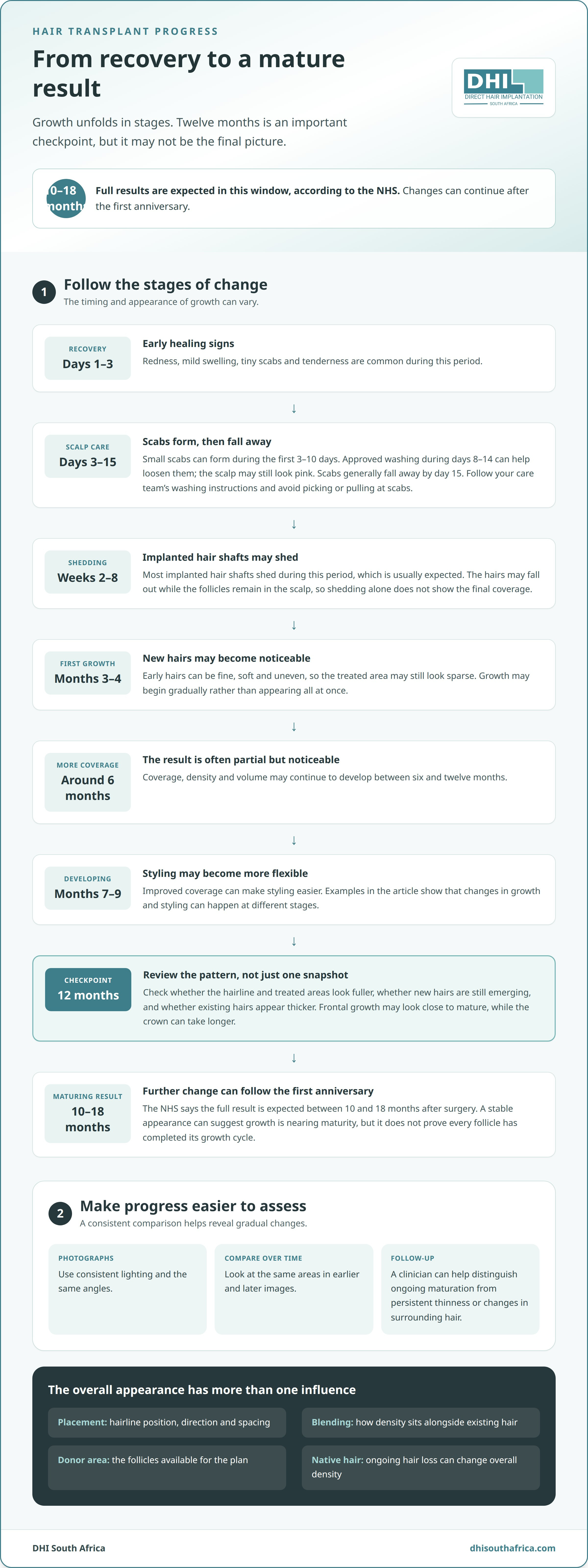
Hair transplant before-and-after photos
Consistent photographs make gradual changes easier to see than memory alone. Take progress photos monthly, keeping the camera position, angle and lighting as similar as possible. Include views of the hairline, temples, top and crown so you can compare each area over time. A different angle or brighter light can make density look different even when the hair hasn’t changed.
Use the same set-up for each photo session. Stand in the same place, face the same direction and keep the camera at the same distance. Photograph your scalp with a similar hairstyle each time: hair combed forwards can cover thinning that is more visible when brushed back. If you change your parting or styling, record it alongside the image rather than treating it as a change in growth.
Take front, side, top and crown views to show the full treated area.
Keep the camera angle, distance and lighting consistent from month to month.
Use similar hair styling in each set, and note any meaningful change.
Save each set by date, so the sequence remains clear during follow-up.
Photos can show the pattern of change between follow-up appointments. Bring the monthly sequence, not just the image you feel looks best. A clinician can compare coverage, the hairline and areas that still appear thin, then consider those observations alongside your treatment timeline. Images support an assessment but don’t replace an examination of the scalp and follicles.
Compare like with like. Assess the crown against earlier crown views, for example, rather than against a frontal photograph. Check whether the hairline position looks consistent and whether the treated area is gaining coverage. At one month, your appearance may be close to how it looked before the procedure, so one early photo can’t represent the later result.
At twelve months, compare the same angles from earlier stages to see how your appearance has changed. Growth may continue to mature beyond this point, particularly at the crown, so keep the photographs for later review. If thinning seems more noticeable in a particular area, note its location and raise it at follow-up. A dated, standardised record helps distinguish changes in styling or lighting from changes in visible density.
For an example of how results can be presented across treatment stages, explore these hair transplant results. Compare the photographs with care: each patient’s starting point, hair characteristics, treatment area and timeline differ. Your own monthly images remain the clearest record of your progress when the position, angle and lighting stay consistent.
Medical treatment after transplantation
A transplant moves follicles but doesn’t stop androgenetic alopecia from affecting untreated hair. Hair loss can continue after surgery, so medical treatment may form part of longer-term care. The aims differ: treatment may address ongoing loss, while implanted follicles add coverage to the treated area. Keeping these aims separate makes follow-up discussions more specific.
During the hair transplant timeline, early shedding and gradual regrowth can make changes difficult to judge. New growth may become noticeable around months 3-4, while the appearance can continue maturing towards 18 months. At the one-year point, assess how your hair has progressed since transplantation alongside any changes in native hair, not just the transplanted area.
Minoxidil and finasteride are examples of medicines used for hair loss. NHS guidance says they don’t work for everyone and only work while they’re used. The NHS also says women should not take finasteride for hair loss. These points matter when discussing ongoing treatment, as suitability and expected effects depend on the medicine and the person using it.
Platelet-rich plasma, or PRP, may be considered alongside other measures. Hair transplant practice guidelines describe PRP as a possible adjunct, not a stand-alone or first-line treatment. This distinction helps set expectations: PRP is considered within a broader plan, rather than as a substitute for understanding the cause and pattern of hair loss.
For a useful review of progress one year after a hair transplant, keep a record of treatment and visible changes. Note when a medicine or other treatment began, any changes in use, and which areas seem thinner. Compare these notes with photographs from different stages, including around 12 months. This record can help distinguish developing transplant growth from continued thinning of native hair during follow-up.
By 18 months, the transplant result may be more mature, but ongoing hair loss can still affect the overall appearance. Surgery and medical treatment address different parts of the picture. A considered plan takes account of transplanted and native hair, the pattern of loss, treatment suitability and changes over time. This gives follow-up a clear focus throughout the period after surgery.
DHI South Africa: Hair Systems & Hairpieces
DHI South Africa offers Hair Systems & Hairpieces for people considering options beyond a transplant. At the one-year point, you may be weighing visible growth, ongoing native hair loss and the appearance you want. A hair system or hairpiece is a non-surgical option, while medical treatments and Direct Hair Implantation address different hair-restoration needs.
The right next step depends on what you want to address. If your priority is changing your appearance without another surgical procedure, Hair Systems & Hairpieces may be relevant. If you’re considering transplantation, discuss Direct Hair Implantation (DHI) in relation to your pattern of loss and donor hair. These approaches serve different purposes, so start with your goals and current hair-loss picture.
Ongoing thinning in native hair can affect how a transplant looks over time. GFC Treatment and Regenera Activa are other options to discuss as part of a wider conversation about hair loss. They differ from transplantation and hairpieces. A treatment plan should distinguish between transplanted hair, surrounding native hair and the appearance you hope to maintain.
It may help to bring your progress photographs and note which areas concern you most. For example, you might be satisfied with the hairline but still notice thinning elsewhere, or prefer a non-surgical option while considering your next step. Discussing these priorities helps keep the conversation focused on your needs, rather than assuming one approach suits every person. You can also explore the available hair restoration treatments in the context of your goals.
A one-year result is a useful point to review how your appearance has changed and what you want from ongoing care. Not every option is suitable for every person. The choice depends on your hair-loss pattern, preferences and the change you’re seeking. Hair Systems & Hairpieces, DHI, GFC Treatment and Regenera Activa are different options, not interchangeable solutions.
If you’d like to discuss which hair restoration option fits your needs, contact DHI South Africa.
Frequently Asked Questions
What does your hair look like one year after a transplant?
At one year, your hair may look fuller in the treated area, but appearance depends on your starting pattern, hair characteristics and styling. Check the hairline, temples and crown separately, as each area can look different. For a useful comparison, take photographs with your hair styled similarly and note whether the same areas remain visible in ordinary indoor lighting.
Is it normal to lose transplanted hair after two or three weeks?
Shedding of transplanted hair shafts can happen after surgery and doesn’t necessarily mean the follicles have been lost. If you notice shedding, record which part of the scalp is affected and whether the change is gradual or sudden. Don’t judge the outcome by loose hairs alone. A clear description and dated photograph can make a follow-up discussion more specific.
Are there any side effects after a hair transplant?
Redness, mild swelling, tenderness and small scabs can occur as the scalp heals. Their appearance may vary between the donor and transplanted areas, so note where you see a change and whether it is improving. Follow your aftercare instructions, especially for washing and handling the scalp. If a symptom concerns you, share its location and progression at follow-up.
How does the 12-month review work?
A 12-month review gives you a chance to discuss what has changed and what still concerns you. Prepare a short record of changes in hair care, medicines or styling, and identify the areas you most want assessed. Bring photographs from different dates rather than relying on memory. This helps focus the conversation on your individual appearance and the questions you want answered.
How long before I start to see the results of a hair transplant?
Early visible changes tend to be gradual, so you may notice a difference in texture or short new hairs before broader coverage. Think of progress as a developing process, not a sudden transformation. Record the first area where you notice a change, then compare it with the same area in later photographs. Styling and lighting can affect what you see.
What does hair transplant progress look like month by month during the first year?
Progress doesn’t follow a uniform sequence: one month may bring little visible change, while another shows new hairs or a difference in texture. Take the same views each month and note changes in hairstyle, lighting or hair length. That context helps explain differences between photographs. Focus on the pattern across the treated area rather than treating each month as a pass-or-fail test.
When are hair transplant results usually fully visible?
The transplanted area’s mature appearance develops at different times for different people and treatment areas. The crown can be harder to assess because hair direction and surrounding density affect how much scalp is visible. Compare photographs taken from the same angle and consider whether your appearance is still changing, rather than using one image to decide that growth is complete.
How much hair growth is expected 12 months after a hair transplant?
There is no single amount of growth that applies to everyone. Hair characteristics, the treated area, existing density and continued loss of native hair all influence overall appearance. Instead of counting individual strands, compare the treated area with pre-procedure photographs and review coverage, hairline shape and styling options. These observations give a more useful picture than an isolated estimate.
Comments