

Hair transplant at 3 months: growth, shedding and appearance

Three months after a hair transplant, a quiet-looking result can still be part of normal progress. At this stage, hair transplant progress may mean little visible change after transplanted hairs have shed, though fine, soft new hairs can begin to appear.
If you’re looking in the mirror and wondering whether anything is happening, that uncertainty is understandable. Shedding can make it seem as though the transplant hasn’t worked, but the follicles can remain beneath the skin and begin producing new hair around months three to four. Early growth is often sparse or uneven, so it may not yet change the overall appearance of your hair.
This guide explains what transplanted hair may look and feel like at three months, why temporary shedding happens and how early growth can develop. You’ll also learn what changes people may notice and when greater thickness and coverage tend to emerge. Progress varies, so compare your results with your own starting point and stage of recovery.
Table of Contents
What does a hair transplant look like after 3 months?
At three months, transplanted hair may still look sparse after shedding, with little visible change. Fine new growth can begin, but noticeable thickening usually comes later.
Shedding and shock loss timing
Shock loss is temporary shedding that can affect transplanted hairs and, sometimes, nearby existing hair. Transplanted hairs commonly shed during weeks 2 to 4 after transplantation, while shock loss can occur between weeks 3 and 8. By around 12 weeks, this shedding is generally over for most patients. The follicles can remain beneath the skin, so shed hairs don’t necessarily mean the transplant has failed.
Individual recovery and maturation
Recovery and hair maturation describe how follicles settle into a new growth cycle and produce visible hair. Around three months, some people may see fine, soft hairs, while others notice little change. Growth varies between patients, and the frontal hairline typically grows faster than the crown. As a result, two people at the same stage can look quite different, even as both progress through expected growth cycles.
Final results and warning signs
Final maturation usually takes 12 to 18 months, and the crown can continue developing during that time. At month three, folliculitis can still occur; MedlinePlus lists scarring, unnatural-looking tufts and lack of transplanted-hair growth among possible complications. These are different from expected shedding, so new or concerning changes deserve attention from the treating clinic.
Between months 3 and 6, transplanted hairs commonly begin to thicken and darken. New growth may initially appear thin, curly or uneven before it gains length and settles. Around six months, coverage and density often become more noticeable, but this is still an interim stage rather than the final result.
The donor area also forms part of the overall recovery picture. After an FUE hair transplant, it is usually healed by three months, with regrowth helping to conceal extraction sites. For an overview of hair transplant treatment in South Africa, the procedure page explains the approach in more detail.
Think of the first year as a sequence of changes rather than a single reveal. Months 4 to 6 often bring more visible growth, while months 9 to 12 show most of the result. Some hair can continue to mature beyond that point, particularly in the crown, so a three-month appearance alone cannot show the outcome.
Expected hair transplant growth at three months
At three months, growth may just be starting, with fine hairs appearing unevenly across the recipient area. FUE and FUT have different surgical approaches, but visible progress depends on the follicles’ growth cycle, not simply the technique. A check of progress three months after a hair transplant may show sparse early growth rather than finished coverage.
Growth milestones and patchiness
Growth milestones describe the gradual return of visible hair as follicles move from rest into active growth. Around three to four months, fine, soft hairs may begin to emerge, but they can be sparse, almost transparent and unevenly distributed. Some patients see little visible change. Patchiness can reflect follicles restarting at different times rather than a final pattern of coverage.
By month four, more hairs may appear, though early coverage can still look irregular. The first visible strands don’t reliably indicate eventual density: they need time to grow longer and thicken. Compare changes across several months rather than judging the recipient area from a single photograph at the three-month mark.
Age and scalp area differences
Age and scalp location can influence how quickly progress becomes visible. Younger patients typically see faster results than older patients, while the frontal hairline usually grows sooner than the crown. This matters when comparing your recovery with someone else’s. A person whose transplant focused on the hairline may notice emerging hairs before someone whose treatment focused on the crown.
Growth rates also vary between individuals, so having surgery on the same date doesn’t mean reaching the same milestones. The recipient area, individual growth cycle and recovery stage all shape what you can see. A crown that looks slower at month three may simply be at a different point in its development than the front.
Early texture and growth direction
Early transplanted hairs can feel and look different from your existing hair. New strands may initially be fine, curly or uneven, then thicken and straighten as they grow longer. This changing texture helps explain why early coverage can appear inconsistent, even when new hairs are emerging across the recipient area.
As strands gain length, their direction becomes easier to see and style. At three months, focus on gradual emergence rather than whether every hair already lies smoothly. Hair commonly thickens and darkens between months three and six, while texture can continue to settle over a longer period.
Month three marks an early growth stage, not a finished result. Months four to six can bring more visible growth, and noticeable coverage often develops around month six. Scissor haircuts are generally possible from around one month if there have been no complications. Ask your treating clinic about dyeing or heat styling, as your scalp’s healing and care instructions matter.
Temporary shedding after transplantation
Shedding after a procedure can temporarily make the recipient area look thinner. Knowing the timing can help distinguish this phase from later hair growth.
Temporary shedding and shock loss
Temporary shedding is the loss of transplanted hair shafts while follicles adjust after surgery. It commonly begins during weeks 2 to 4, while shock loss can occur between weeks 3 and 8. Shock loss describes temporary shedding of transplanted or nearby existing hairs. Around 50 to 60% of patients experience noticeable shock loss, so a change in density during this period is not unusual.
The shed hair is not the follicle itself. Visible strands can fall while follicles remain beneath the skin and later resume growing. Shedding may also affect surrounding native hair, making the recipient area seem less dense than before the procedure. The timing and amount vary between patients.
The quiet phase after shedding
After shedding, follicles can enter the telogen phase, a resting stage in the hair growth cycle. This quiet period lasts about 2 to 2.5 months after shedding, so little visible growth may follow straight away. Knowing this helps explain why a patient can see minimal change even after the initial loss has stopped.
For example, hairs that shed during weeks 2 to 4 may remain out of sight through the following resting phase. The follicles are still part of the recovery process, but they are not yet producing noticeable strands above the scalp. As a result, the area can appear unchanged or temporarily sparse.
Hair growth often starts to become visible around months 3 to 4. New strands may first look fine, soft or uneven, rather than adding immediate density. The first signs can be easy to miss under longer surrounding hair, or more obvious in a closely cropped style. Appearance alone at this stage does not show the full growth cycle.
By around 12 weeks, shock-loss shedding is generally over for most patients, but that does not mean visible growth has fully begun. The next phase is gradual: follicles restart at different times, and early hairs need length to become noticeable. Month three can therefore feel quiet, even as the recovery timeline continues beneath the surface.
Track changes at consistent intervals, such as with monthly photographs in similar lighting. Comparing the same angle and hair length makes changes in coverage easier to see than daily checks. If shedding or scalp changes seem unusual, follow the post-operative guidance provided by your treating clinic.
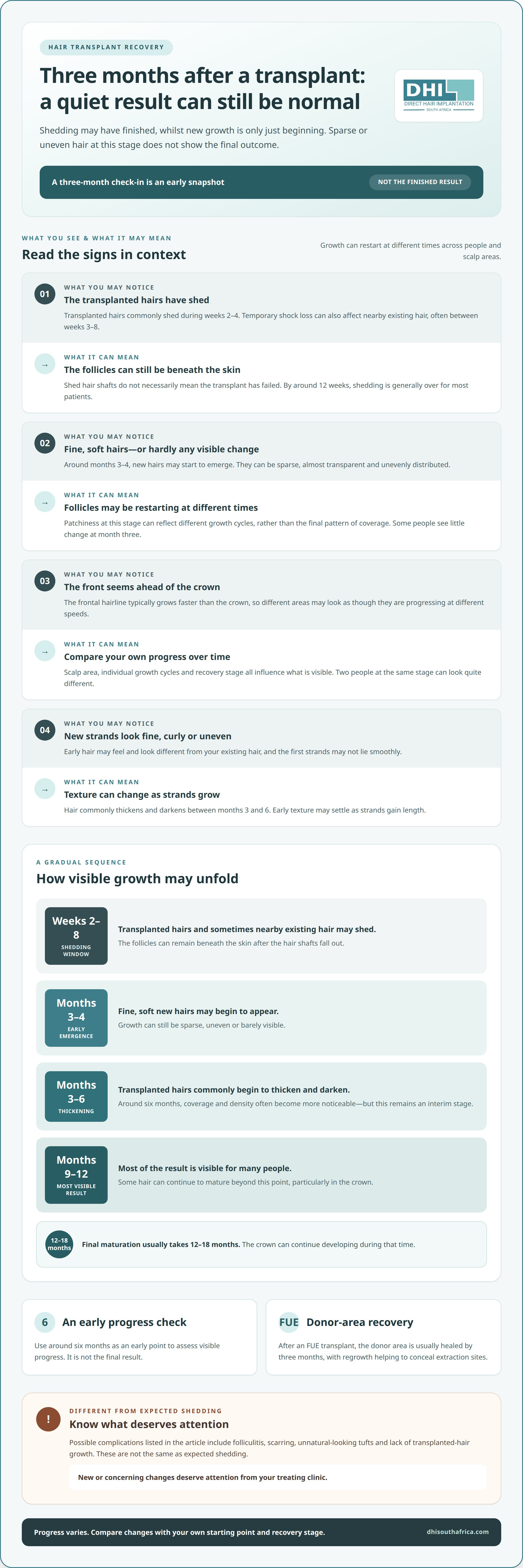
Expected hair appearance three months after surgery
Three months after surgery, the scalp may look settled, but coverage can remain limited. The transplanted area might show scattered fine hairs, visible gaps or little change. For example, a hairline with a few emerging strands can still look thinner than the surrounding hair because follicles restart growth at different times.
The “ugly duckling” phase usually spans weeks 6 to 12 after surgery. During this interval, shedding may leave the recipient area looking less full than before treatment. At week 12, sparse growth, slight unevenness or contrast with existing hair can be noticeable. This describes a temporary appearance, not the final density.
By month three, most early signs of scalp healing should have passed. The donor area is usually substantially normal by weeks 7 to 9. The recipient area may still look uneven, while short new hairs can be difficult to see beneath longer surrounding strands. This contrast can make the result appear different in close-up photographs and everyday viewing.
New hairs emerging around months 3 to 4 may look fine, light-coloured, curly or irregular in direction. As they lengthen, they can thicken and darken, so a strand seen at month three may not resemble its later appearance. To compare changes, take monthly photographs using the same angle, lighting and hairstyle. Daily mirror checks make subtle progress harder to distinguish.
Visible coverage usually builds after this early stage. Around month six, growth and thickening are commonly more noticeable. Density and volume can continue increasing between months 6 and 12. Most results are visible around 12 months, although crown results may keep maturing through months 12 to 18. Month three is an early snapshot, not a final assessment.
Look for gradual changes across several photographs, such as more fine strands along a previously sparse hairline or increasing coverage between existing hairs. Comparing the same view at month three and month six can make emerging growth easier to see than relying on memory. Hair restoration develops in stages, so texture, length and density won’t necessarily change together.
Examples of three-month transplant results
At month three, results can range from almost no visible change to scattered, fine new hairs. These examples show why it’s better to assess progress in stages than to judge it from one photograph. A photograph taken three months after a hair transplant is an early snapshot, not a prediction of final density.
Examples of early transplant results
Consider a patient whose recipient area looks much as it did after shedding: the hairline remains sparse, with only a few fine strands appearing. Another may notice short, soft hairs emerging unevenly across the treated area. Both are possible at three months, when growth may only just be starting. Photographs can look considerably different from one patient to another.
At month six, the comparison can look different. Hair growth and thickening are usually more noticeable, although coverage remains partial. Many patients reach around 60 to 70% density by this point. For example, a hairline that showed isolated hairs at month three may have more visible coverage at month six, without yet showing its mature appearance.
These examples aren’t a prediction for every patient. The recipient area, individual growth cycle and technique can all shape what appears first. A frontal hairline may show progress sooner than a crown, so comparing photographs without considering which area was treated can give a misleading impression.
Assessing transplant results
Month six is a useful early comparison point, not a final verdict. Compare photographs from month three and month six using the same angle, lighting and hairstyle. Look for specific changes, such as more visible hairs along the hairline, greater coverage between existing strands or increased thickness across the recipient area.
At months 9 to 12, most of the final result is visible. The hairline may appear more settled by months 10 to 12, while the crown can keep maturing through months 12 to 18. These stages matter because a slower crown at month six doesn’t necessarily match the progress seen at the front.
Use month three to record an early reference, month six to assess partial growth, and months 9 to 12 to review broader coverage. Keep photographs consistent at each step. Hair can continue thickening after month 12, particularly at the crown, so consider both the treated area and time since surgery when reviewing your progress.
A single close-up can exaggerate gaps or make fine hairs hard to see. Compare the whole recipient area in similar photographs at months three, six and 12. That sequence shows how early strands can develop into more visible coverage, while keeping each stage of the timeline in view.
DHI South Africa: Hair Systems & Hairpieces
Waiting for transplanted hair to mature can feel like a long stretch, especially when month three brings little visible change. Hair Systems & Hairpieces offer another option if your immediate priority is the appearance of coverage rather than waiting for natural growth to develop.
A hair system or hairpiece addresses the appearance of thinning; it doesn’t make transplanted follicles grow faster or change their recovery cycle. At three months, new hairs may only just be emerging, while fuller results typically take longer to develop. An appearance-focused option may suit someone seeking coverage in the meantime or who prefers not to rely on early, uneven growth.
There isn’t one choice for every hair-loss situation. Your goals, existing hair and preferred approach all matter. Direct Hair Implantation (DHI) is a transplant option for people considering surgical hair restoration, while Hair Systems & Hairpieces address appearance without waiting for transplanted hair to mature. DHI South Africa also offers GFC Treatment and Regenera Activa. These are distinct options, and the right discussion depends on what you want to address.
If you’re already in recovery, keep the stages in perspective. Month three is an early point, and visible density commonly continues to develop between months six and twelve. A hair system or hairpiece may be worth considering if you want to address the appearance of thinning in the meantime. It should be weighed against your current recovery and personal goals, not used to judge whether a transplant is working.
For someone not pursuing a transplant, Hair Systems & Hairpieces may still be relevant as an appearance-focused option. For someone considering DHI, the conversation can centre on the longer growth timeline and whether this approach matches their aims. These paths aren’t interchangeable: one addresses visible coverage, while a transplant aims to restore hair growth in the treated area.
Choosing what feels appropriate is personal. DHI South Africa can discuss Hair Systems & Hairpieces and hair restoration options in relation to your goals, without assuming that one approach suits everyone. Contact DHI South Africa if you’d like to talk through the options.
Frequently Asked Questions
Has shedding stopped by 3 months?
Shock-loss shedding is generally over for most patients by around 12 weeks, although individual timing can differ. This doesn’t mean new hair must already be visible: follicles can remain in a resting phase after hairs fall. If you’re taking progress photographs, compare the same area and lighting each month. That can help distinguish ongoing sparse coverage from a gradual change in the recipient area.
How long before I start to see the results of a hair transplant?
Early signs of new growth can appear around months 3 to 4, but the first hairs may be fine and difficult to spot. More visible coverage often develops around month 6, with most results visible around months 9 to 12. For example, a hairline may look more defined before the crown shows comparable change. Final maturation can take 12 to 18 months.
What are the hair transplant growth stages, week by week?
During days 1 to 3, redness, tenderness and small scabs can appear. Scabs form around days 2 to 3; swelling generally settles during days 4 to 7. From days 8 to 14, scabs loosen with approved washing. Shedding commonly occurs during weeks 2 to 4, and shock loss can continue through weeks 3 to 8. Around months 3 to 4, early growth may begin.
What does the scalp look and feel like?
In the first days, the scalp can be tender, red and slightly swollen, with small scabs around implanted follicles. By day 14, most scabs have cleared, though the scalp may still look pink during days 8 to 14. At three months, the donor area is usually substantially healed. The recipient area may look sparse while new hairs emerge.
What does hair transplant growth look like 3 months after surgery?
At three months, you may see isolated, fine hairs rather than an even layer of coverage. Some can look pale, soft or slightly curled, making them less noticeable against surrounding hair. For instance, a few short strands along the hairline may show in close-up photographs but be hard to see at a glance. The appearance partly depends on which scalp area was treated.
Is shedding or shock loss normal 3 months after a hair transplant?
Shock-loss shedding usually occurs earlier, most often between weeks 3 and 8, and is generally over by around 12 weeks. Follicles can then remain in a resting phase before visible growth resumes. A small amount of variation in timing is possible. If you notice a new or unexpected change in your scalp, discuss it with the clinic responsible for your treatment.
How much hair regrowth is typical at 3 months after FUE or FUT?
There isn’t a reliable amount of visible regrowth to expect at three months for either FUE or FUT. Early hairs can be sparse, fine or uneven, and some patients see very little change at this stage. The treated area and each person’s growth cycle affect what appears. FUE donor areas are usually healed by three months, but that doesn’t indicate recipient-area density.
When do hair transplant results usually become visible and reach full maturity?
Noticeable coverage often develops around month 6, while most results are visible around months 9 to 12. Full maturation generally takes 12 to 18 months, and crown growth can continue during that later period. For a practical comparison, review photographs from months 3, 6 and 12, using similar lighting and angles. This shows change over time rather than relying on one snapshot.


Comments