

Hair transplant payment plans for patients in South Africa

A poor credit record does not, on its own, determine whether you can use payment plans for hair transplants in South Africa. Financing terms vary by lender and may depend on the amount borrowed, your credit score and the repayment period. The practical step is to review those factors rather than assume your credit history settles the question.
It’s understandable to want clarity before committing to treatment, especially when you’re balancing a deposit and monthly repayments against other expenses. This guide explains how clinic-backed instalments may work, what can affect the total treatment cost, and how payment methods compare. You’ll also learn which costs to factor into your budget so you can approach the decision with a clearer picture of the financial commitment.
Table of Contents
Clinic-backed monthly instalments
In South Africa, clinics that arrange internal financing may offer monthly instalments, but terms vary between clinics. Payment plans for hair transplants are therefore best compared by deposit, repayment period, interest and total payable, rather than by the monthly amount alone.
Flexible payment plans
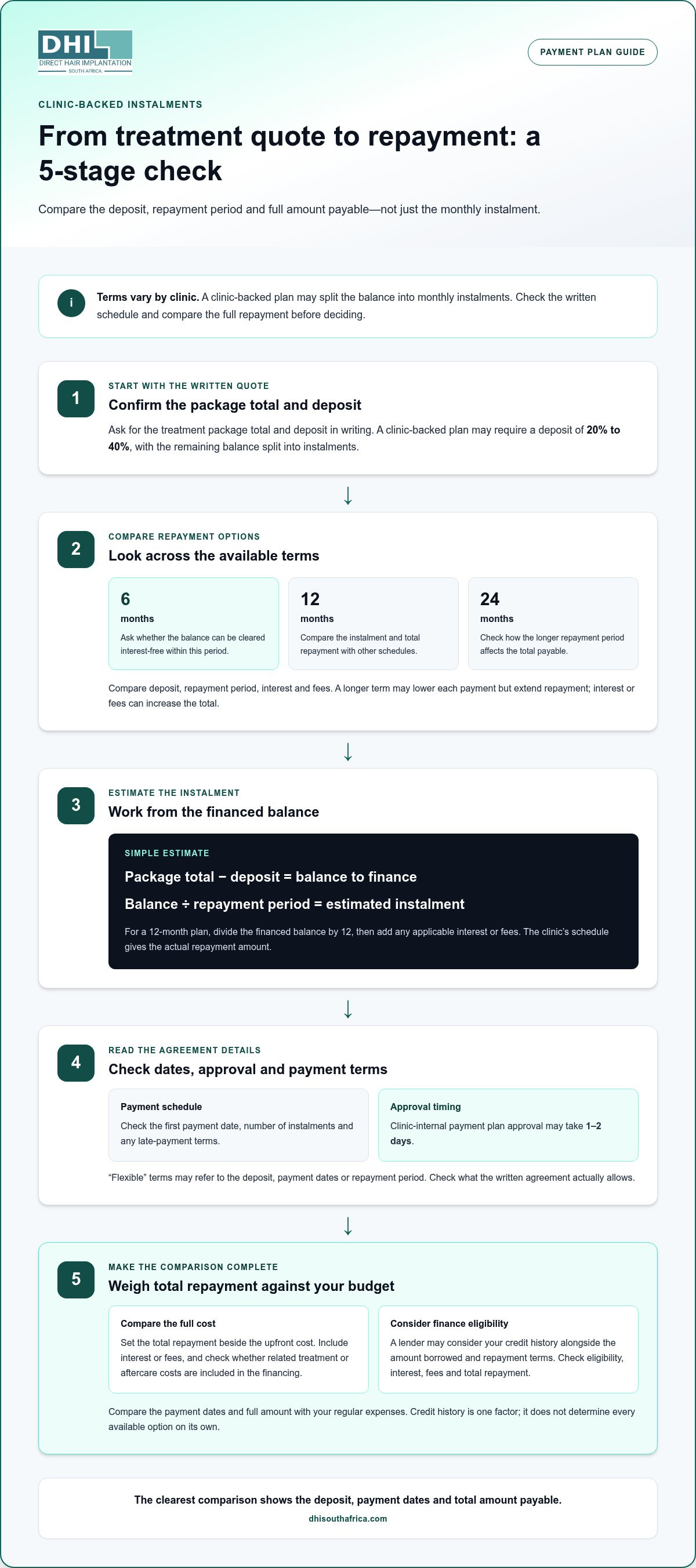
A clinic-backed plan may require a deposit of 20% to 40% of the treatment package, with the remaining balance split into instalments. Repayment periods may be 6, 12 or 24 months. Ask whether the clinic offers interest-free financing if you clear the balance within 6 months, then compare that option with longer repayment terms.
Check what “flexible” means in the written agreement. It may refer to the deposit, payment dates or repayment period, rather than allowing changes at any time. Compare the upfront amount with the balance financed, and make sure the schedule matches the agreed treatment plan. Assess payment plans for hair transplants by the full amount you’ll repay, including any interest or fees.
Estimated monthly payments
To estimate an instalment, subtract the deposit from the package total and divide the remaining balance across the agreed repayment period. For a 12-month plan, for example, divide the financed balance by 12 before adding any applicable interest or fees. The clinic’s schedule gives the actual repayment amount.
Compare the monthly instalment with the total repayment. A longer term may lower each payment but extend the repayment period, while interest or fees can increase the total. Payment plans for hair transplants are easier to compare when the estimates use the same treatment total and deposit.
Clinic-internal payment plan approval may take 1-2 days. Include that timing in your planning, and review the schedule before agreeing. Check the deposit, first payment date, number of instalments and any late-payment terms together. These details show how the arrangement fits your monthly budget, not just what you owe initially.
A lender may consider your credit history alongside the amount borrowed and repayment terms. Credit does not determine every option on its own. Compare the finance available to you by checking eligibility, interest, fees and total repayment. Keep the financing decision separate from your choice of treatment.
Use these steps to compare an offer:
Get the package total and deposit in writing.
Compare the available 6-, 12- and 24-month schedules.
Ask about interest-free terms for balances cleared within 6 months.
Compare total repayment with the upfront cost.
Check approval timing and the first payment date.
A written payment schedule makes the commitment clearer before you decide. Compare the full amount and payment dates with your regular expenses, then choose a repayment structure that fits your budget.
Factors determining the final treatment cost
A hair transplant estimate in South Africa reflects the proposed treatment plan and what it includes. Comparing clinics on affordability alone can hide differences in the treatment area, hair placement and procedure details. Review the clinical plan alongside the estimate to understand what each amount covers.
Procedure-cost estimates and consultations
A consultation helps determine the treatment area, hairline design and number of hairs proposed. These details, the technique and package inclusions shape the procedure estimate. The price depends on the case and is given after a quote request. Compare South African estimates by reviewing their treatment plans and inclusions, not just their headline totals.
Review the treatment plan beside its cost breakdown. Identify what is included, what is listed separately and which technique is proposed. This connects the estimate to the work planned for your hairline and other treatment areas. A hair transplant treatment plan can help you understand the clinical elements behind an estimate.
Cost per graft
Some estimates use a cost per graft as their pricing unit. This can show how a clinic calculates its charge, but it does not replace the treatment plan’s assessment of how many hairs are needed or where they will be placed. Read any unit rate alongside the overall estimate.
To compare per-graft estimates, check that they cover the same treatment scope and inclusions. Then consider the total amount, rather than treating a lower unit rate as proof of a lower overall cost. The proposed hairline, treatment area and placement plan describe the clinical work; the graft unit is simply a way to express price.
South African hair transplant estimates are based on the proposed treatment, not one figure that applies to every case. The treatment area, placement plan, technique and included items all contribute. A plan for a defined hairline may differ from one addressing broader thinning.
Comparisons are useful when estimates cover equivalent work. Match the treatment area, hairline goals, technique and package inclusions before comparing totals. This helps distinguish like-for-like estimates from plans with a different clinical scope or different included items.
Affordability matters, but a lower upfront amount may reflect a different treatment plan. Review what the procedure covers, how hair placement is planned and which items fall outside the package. These details put the proposed cost in context more usefully than a single price label.
Use this sequence to assess an estimate:
Match the treatment area and intended hairline design.
Review the proposed number and placement of hairs.
Compare the technique and package inclusions.
Use any per-graft rate only as a pricing unit, then compare total charges.
A clear breakdown connects the proposed procedure with its cost. Compare South African estimates after matching their clinical scope, and use the full plan to understand what each amount covers.
Deposit and pre-surgery payments
A deposit changes how much remains to pay before surgery, so understand its role within the full treatment agreement. For patients budgeting in South Africa, the key steps are to identify what the deposit covers, when it is due and how later payments are scheduled.
Start with the written treatment plan. It should connect the deposit to the agreed procedure total, rather than leaving you to infer whether it is an additional charge or part-payment. For example, if the plan describes a deposit as part of the total, the remaining balance is the amount still to fund before or through the payment plan.
Next, check the payment dates against the planned procedure. The schedule may specify an initial payment, later payments before treatment and any balance due on a set date. It should state each amount, due date and payment method, giving you a sequence to compare with your income and existing commitments.
Deposit arrangements vary. One plan may require the full deposit at booking, while another divides payments into agreed stages. Use the written agreement as your reference: check whether each payment reduces the outstanding balance and whether a change to the procedure or date affects the schedule.
Before paying, read the terms for cancellation, rescheduling and changes to the treatment plan. They explain how payments already made are handled if your arrangements change. Keep the written terms and payment records together, including receipts, the agreed treatment plan and the instalment schedule, so you can track the balance.
If a lender is involved, establish which part of the cost it will finance. It may fund the balance rather than the deposit, so compare the clinic’s payment schedule with the lender’s disbursement process. Record who receives each payment, when the funds are released and whether anything is due directly before treatment.
Use this pre-surgery checklist before transferring funds:
Match the deposit to the written treatment total.
Record every pre-surgery due date and payment amount.
Identify whether the clinic or a lender receives each payment.
Read the cancellation and rescheduling terms before paying.
Keep receipts and update the remaining balance after each payment.
A clear payment sequence shows the financial commitment, not just the first amount due. If the treatment plan changes, compare the revised total with what you’ve paid and the remaining balance before proceeding.
Factors that affect hair transplant costs
Two treatment plans can differ even when both address thinning hair. In South Africa, the planned area, number of hairs, technique and complexity all shape the work involved. Assess each factor against your own hair restoration plan, rather than assuming a similar-looking result requires the same procedure.
The treatment area is a useful starting point. A small section of the hairline may need a different plan from broader thinning across the scalp. The doctor assesses the areas to be treated and the desired coverage, helping explain how the extent of the procedure affects the plan.
Hair quantity also matters. The plan considers how many hairs are needed, where they will be placed and how the donor area can support the proposed coverage. Some estimates use grafts as a unit, but a graft can contain more than one hair. Ask how the estimate connects its graft count with the intended hair placement.
The technique affects how follicles are extracted and placed, so different approaches should not be assumed to have identical costs. Before comparing plans, understand which technique is proposed and how it relates to your hairline, coverage needs and clinical assessment.
The complexity of a procedure can affect its planning. Restoring a defined hairline may require detailed placement decisions, while treating a wider area calls for broader coverage planning. The doctor also assesses the available donor area when designing the proposed treatment. These clinical details are more useful than a generic estimate.
Financing affects affordability, not the treatment scope. A manageable upfront amount can still lead to a higher total payable because of interest, fees or the repayment term. Lenders may also consider the amount financed, credit score and repayment terms when assessing an application. Review the treatment estimate and borrowing costs separately.
Use these steps to understand what drives an estimate:
Identify the treatment area and the intended coverage.
Review the planned number of hairs and how any graft count relates.
Understand the proposed technique and the work it involves.
Compare the clinical plan before comparing financing options.
Calculate the full repayment total, not only the upfront amount.
For example, a plan focused on the hairline and one addressing wider thinning may involve different placement requirements. Read each estimate alongside its treatment plan. A clear breakdown shows what each proposed procedure covers and why the amounts may differ.
FUE is generally more expensive than FUT. When comparing estimates, check which technique each plan uses and consider that difference alongside the treatment area, hair quantity and complexity. A lower figure should not be judged in isolation; review the proposed plan and financing separately so the comparison reflects both the clinical scope and the amount payable.
Hair transplant payment methods
In South Africa, financing may come through a clinic arrangement, personal loan, medical lender or buy-now-pay-later platform. Compare eligibility, repayment terms and the total transplant cost, not only the monthly amount.
Clinic arrangements, personal loans and medical credit differ in who provides the funds, how they are paid and how repayments are set. The questions below can help you compare options and identify what to review before signing.
Clinic plans, personal loans and medical credit
A clinic plan sets repayments through the clinic, whilst personal loans and medical credit involve a lender. Medical lenders may offer terms of 24 months or longer, with approval taking 2-3 days. Financing costs vary by lender, amount borrowed, credit score and repayment terms, so compare the total repayment alongside the monthly instalment.
Possible routes include clinic arrangements, personal loans, medical lenders and buy-now-pay-later platforms. Compare the product terms and how funds reach the clinic; no single option suits every applicant.
Financing application documents and eligibility
Eligibility depends on the lender, the amount financed, your credit score and the proposed repayment terms. Document requirements vary, so review the lender’s application instructions before applying. Use consistent information in your application and treatment estimate.
Some buy-now-pay-later platforms use a soft credit check during an initial enquiry, which does not affect your credit score. An enquiry is not approval, so understand the lender’s decision process and repayment conditions before relying on financing.
Medical aid or health insurance should not be assumed to cover a hair transplant in South Africa. Such procedures are generally classified as elective cosmetic treatment and are usually not covered. Rare exceptions may apply when treatment is medically necessary after scalp burns or injuries.
Before choosing a lender, establish whether funds go directly to the clinic or into your personal account. If a plan includes related expenses, identify whether it covers surgery, PRP or Exosome therapy, post-operative medication, hotel nights and transfers. For monthly payments in another currency, account for currency conversion fees.
Before signing, compare the written contract with the treatment estimate. Confirm the amount financed, repayment dates, interest, fees, late-payment terms and total payable against the upfront transplant cost. Check which services and expenses the financing covers, and whether the agreement specifies how changes to treatment affect the balance.
A useful comparison sets out four details side by side: monthly repayment, repayment period, total payable and what the funds cover. This makes clinic arrangements and external credit easier to compare, particularly when a lower monthly payment means a longer repayment term.
DHI South Africa: Direct Hair Implantation (DHI)
DHI South Africa offers Direct Hair Implantation (DHI) for people considering a hair transplant. If you’re weighing treatment options and financing, the next step is to understand which approach suits your hair loss and what the proposed plan includes.
DHI South Africa also offers GFC Treatment, Regenera Activa and PRP Hair Loss Treatment. These are treatment options, not payment methods; the suitable approach depends on your hair restoration needs. A consultation can clarify the proposed treatment before you consider how to budget.
If you’re ready to discuss your options, contact DHI South Africa.
Take your next step with clarity
Choosing a hair restoration approach is personal, and financing is only one part of the decision. Use what you’ve learned about payment plans for hair transplants to consider how repayments fit your budget, then discuss your treatment goals with DHI South Africa. A consultation can help you understand the options and the proposed plan.
DHI South Africa offers Direct Hair Implantation (DHI), GFC Treatment and Regenera Activa. A consultation can help you understand how these options relate to your hair restoration goals, so you can consider treatment and budgeting together.
Contact DHI South Africa to discuss your needs and the next step towards a suitable treatment plan.
Move forward at your own pace, with a clearer understanding of your options.
Frequently Asked Questions
Do you work with patients with bad credit?
A poor credit record does not, by itself, determine whether you can pursue treatment; financing approval is a separate lender decision. Lenders may consider your credit score alongside the amount borrowed and repayment terms. Review the lender’s eligibility criteria and total repayment before committing. Some buy-now-pay-later platforms use a soft credit check during an enquiry, which does not affect your score at that stage.
What deposit is required for a hair transplant payment plan in South Africa?
Clinic-backed plans commonly require a deposit of 20% to 40% of the total package. The amount due depends on the plan’s deposit terms and the treatment package total. Before paying, make sure the written schedule shows whether your deposit reduces the balance, when it is due, and how later payments are collected. Keep the schedule and payment receipt so you can track the remaining amount.
What is the average cost of a hair transplant in South Africa, and how do prices vary by graft count?
South African hair transplant costs are case-specific, so a single average may not reflect your treatment plan. The quoted amount depends on the clinical scope, technique, package inclusions and number of grafts proposed. A graft count alone doesn’t determine the total: two plans with similar counts may cover different areas or include different items. A quote request provides the cost for the proposed case.



Comments